
Recommended Audience: None.
Opinion: Pass. Not recommended.
While this book provides an opportunity to learn about Jewish culture, specifically bat mitzahs, Bri’s disinterest in her faith and other advisories make this book a no-go for me.
Details:
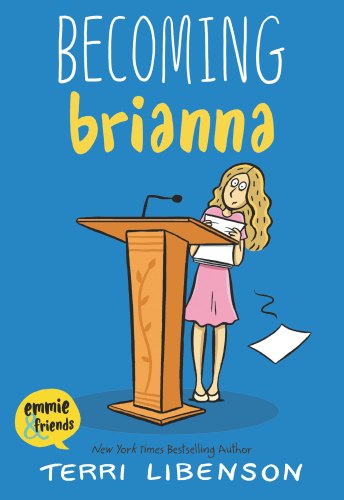
This is another book I had a hard time with. On the one hand, I believe that it’s really important for our readers to learn about other faiths and cultures, and their respective traditions. And for that reason, I liked this book. This story is about title character Brianna preparing for her bat mitzvah, a Jewish rite of passage. As she prepares, she questions her reasons behind agreeing to the bat mitzvah in the first place and if this tradition, and furthermore faith, is something she really believes in.
As a parent of faith whose roots are intertwined with Judaism and Christianity, Brianna’s resistance to learn and observe her faith is a bit off-putting. I wouldn’t want my own children to behave in such as way when it comes to Islam. When Brianna narrates how she “put her foot down” and refused to attend religious school in fifth grade because she had “more important things to do,” it bothered me, because again, this is not something I would want my own child to emulate in regards to their own faith.
On the flip side, as a Muslim parent, I don’t feel AS challenged by Brianna’s questioning of Judaism and Jewish rites. Brianna’s unwillingness to “blindly follow” is not threatening to me. It does get a bit complicated however because some of her sacrilegious thoughts regarding Judaism, carry over into Islam as we share many prophets (peace be upon them all) and narratives.
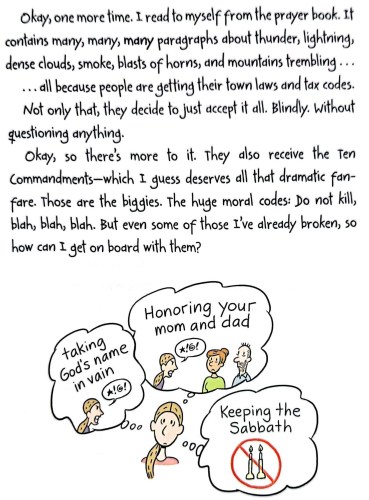
As an example, when describing her Jewish prayer book, she says “It contains many, many, many paragraphs about thunder, lightning, dense clouds, smoke, blasts of horns, and mountains trembling… all because people are getting their town laws and tax codes. Not only that, they decide to just accept it all. Blindly. Without questioning anything.” (p.161) The sarcastic tone used when referring to God’s commandments to the Jewish people didn’t sit well with me.
Ultimately, I have to ask myself if the value the book brings to the table is worth dealing with the issues it contains. In this case, I leaned with “no.” In addition to the concerns above, other advisories (outlined below) pushed this book just over the edge for me. I think there are other ways for our children to learn about other faiths and cultures in a respectful, engaging way. This book doesn’t have to be part of that journey. This book is far from the worst when it comes to questionable content, but if I’m in the position to say which books I would put in front of our Muslim kids, this is one that I wouldn’t recommend.
Things I Liked:
- Brianna is a child of divorcees, bouncing between her two parents’ households. I appreciated that readers who might be living in similar situations will be able to relate
- learning about the traditions and vocabularies of a bat mitzvah; it was insightful to see all that goes into the planning of the event and Bri’s mom’s antics were humorous
- overall there wasn’t a heavy emphasis on topics that I would consider inappropriate
- Bri’s rabbi seems friendly and approachable; I liked this because sometimes religious characters can be portrayed otherwise, simply because they are religious
Advisories:
- an infographic seems to depict a variety of “non-traditional” families, including gay and lesbian couples (p. 18)
- Brianna narrates that in fifth grade, she “put her foot down” and refused to go to religious school because she had “more important things to do” and “wasn’t that into it” — I’m concerned this is sending the wrong message to our readers (p. 20)
- talks about liking boys (p. 35, 37, p. 82)
- Brianna questions her beliefs in Judaism and its rituals (p. 71)
- Brianna’s aunt talks about being an atheist (p. 115)
- Bri’s father reflects on when he asked a girl out on a date (p. 127-129)
- depiction of physical contact (hugs) between girls and guys (p. 138)
- sacrilegious talks about God’s interactions and commandments with the Jews (p. 161)
- party of middle school boys and girls dancing together depicted (p. 301-309)
 Illuminated Pages