
Sanity & Tallulah (Graphic Novel)

Book 1 of the Sanity & Tallulah Series* by Molly Brown

* This review is ONLY for the book described in this post, NOT the series in its entirety.
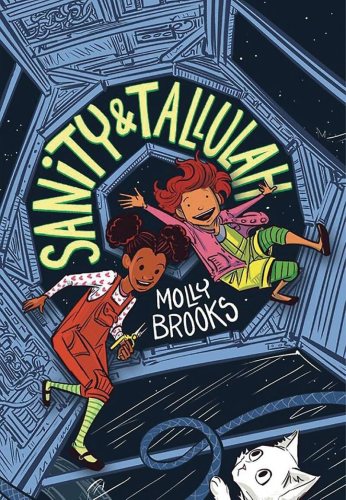
Recommended Audience: Middle School and Up

Opinion: Recommended w/ Advisories

Synopsis: This action-packed graphic novel would be a great find for science fiction lovers ages 10 years+. Readers tag along as best friends Tallulah and Sanity work to figure out who–or what–is wreaking havoc on their beloved space station. Could it be Sanity’s recently-escaped science experiment–a cuddly three-headed kitten–or something else? While there aren’t many overt moral lessons, the story is entertaining and enriching. If your reader enjoyed the cat-chasing antics of novel Grounded by Aisha Saeed, they’ll likely enjoy this book as well.

Advisories: lying, sneaking around, one LGBT+ inference, moderate crude language

Details:

This was a fun, engaging read filled with action and fun sci-fi STEM jargon. Sanity and Tallulah are best friends and partners-in-adventure living on a futuristic space station. When someone, or something, starts causing damage throughout the station, they suspect it might be Sanity’s latest science experiment: a three-headed kitten that has escaped from the lab! The two girls quest to find their fugitive furry friend without getting in to too much trouble along the way.
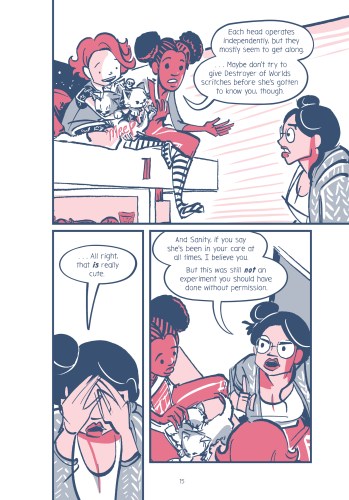
This was a captivating graphic novel that I would encourage my Middle Schooler to read. Engaging storytelling, strong female leads, STEM representation, and opportunities for critical thinking make this book of value for readers. I would recommend it for even younger grades if it weren’t for the moderate crude language (damn, hell, etc.) and higher-level sci-fi concepts and vocabulary that might leave them a bit lost. The illustrations’ limited color scheme and frequent transitions from dark to light palettes left something to be desired for me, however. If I were to put this on my shelf at home or in an Islamic school library, I’d censor the one LGBT+ inference found on p. 157.

Things I Liked:

  • engaging, fast-paced storytelling
  • diverse cast of characters
  • STEM/sci-fi related themes and vocabulary
  • strong female friendship
  • fun adventure with an element of mystery

Detailed Advisories:

  • sneaking around/trespassing (recurring) (p. 25, 32, 119)
  • death of pets (p. 56-57)
  • lying (p. 59)
  • moderate crude language (heck, damn, jerk, hell) (p. 125, 130-1, 143, 145, 179, 222)
  • one LGBT+ inference — male character says he had a crush on another male character in grade school (p. 157)
  • dead animals (p. 166)

Advisories Note: This list of advisories is not exhaustive and may not capture every instance of questionable content, but rather is intended to give an overall sense of the content of the book.
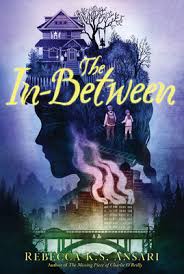
The In-Between

by Rebecca K.S. Ansari

Recommended Audience: Middle School+

Opinion: Recommended w/ Advisories

Rating: 10/10

Synopsis: Cooper’s sister Jess finds an unsolved mystery online about a deadly train crash that happened a hundred years ago. But one passenger was never identified and the only clue about him was a logo on his jacket. Then they find out that the girl that just moved next door has the same logo on her jacket! Cooper and his sister team up to find the truth about the girl.

Lessons learned: The feeling of a boy whose dad died

Advisories: In this book they mention a place called “The In-Between” which is supposed to be between life and the afterlife

ADMIN NOTE: A major setting of this is a time/space known as the “in-between” that is between life and the afterlife. Parents are encouraged to have a discussion with their child about the Islamic concept of the barzakh (the stage between life and the afterlife) to clarify and reinforce Islamic theological concepts in juxtaposition to this book.

Awkward (Graphic Novel)

Recommended Audience: Middle School +

Opinion: Recommended

Rival school clubs learn to work together after weeks of contention. Readers get to experience doing the right thing when faced with a moral dilemma, putting aside differences to work together, standing up to bullies, and more.

Advisories for mild crude language (e.g. pissed, jerk, idiot), mean-spirited jeering and name-calling (e.g. losers, dork), one reference to the ‘B-word’

Details:

At first glance of the cover, I automatically assumed that this book would have an overarching romance theme. Surprisingly, it doesn’t at all. The story revolves around two students, Penelope and Jaime, and their respective rival art and science clubs. Complete with middle school angst and melodrama, this book is quite humorous and overall wholesome. Aside from the name-calling and pranks, there’s really little to point out in terms of morally questionable content. However, if you wish to avoid stories that have a boy-girl friendship, this will be a book you would want to skip.

I think that middle school readers and up (perhaps even a mature 5th grader) will really enjoy this book. I love that the author relayed the message that art and science don’t have to be exclusive, and that in fact many famous people have been adept at both (p.188-190). Of course, I wish that the author had expanded the examples she gave beyond the Renaissance and Leonardo Da Vinci, but we’re not there yet. The scene where students stood up to the class bullies was a delight (p.208).

Things I Liked:

  • diversity of characters — the brilliant science teacher is a fierce woman of color, Jaime’s mom is in an electric wheelchair, and the newspaper staff reporter is a hijabi
  • resolution of conflict – ultimately the rival science and art clubs work together to achieve something great
  • doing the right thing – when faced with a moral dilemma, main character Penelope makes the right choice
  • consequences for the constant bickering and fighting between the two clubs
  • comedic elements – there were many comedic elements that didn’t come at the expense of character’s feelings

Advisories:

  • a vague inference to mammals having breasts (p.41) — I honestly think this would fly over most kids’ heads unless they’re familiar with mammals, and even then, it’s not really that bad
  • name-calling/teasing throughout (e.g. dork, nerd, losers)
  • mild crude language (e.g. pissed [p.93], stupid)
  • a character’s parent referring to the character’s mom as her “lazy BXXXX mother” (p. 104) — this is literally how it is written (with the X’s as it appears). I honestly don’t see why the author felt the need to include this. They could’ve got the same sentiment across without throwing in the expletive, even if it is written in a covert way.