The Breakaways (Graphic Novel)

Recommended Audience: NONE

Opinion: NOT recommended.

Advisories: bullying, harassment, LGBT+ characters, LGBT+ romance, transgenderism

Details:

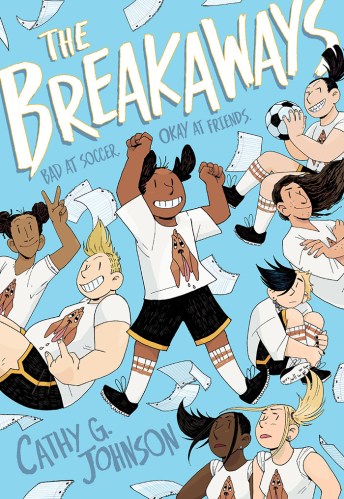
If you are someone who prioritizes mainstream Islamic values (which you likely are, since you’re on this website), this is not the book for you or your children. The overall plot offers nothing positive whatsoever. There is constant bullying and harassment between all the characters. They are all on a soccer team that they couldn’t care less about and ultimately decide that the best thing to do would be to completely abandon the team altogether mid-game. Not exactly the values I’m looking to instill in my kids.

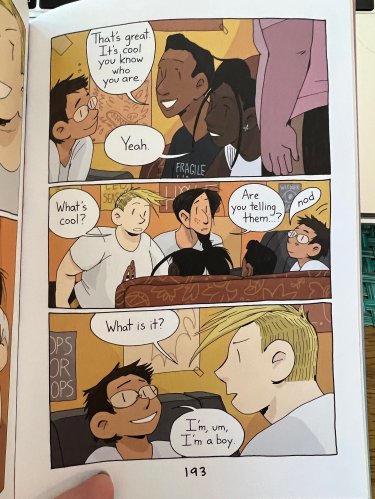
Furthermore, there are very pro-LGBT+ messages conveyed in the book. A character comes out as trans (female to male) which the other characters affirm and support, and then said character proceeds to kiss another girl. Yet another character comes out as a lesbian and the other character is happy for her.

I was further shocked to learn the target audience for this book is middle grades (ages 8 – 11)! These seemed like really adult themes for young children! The only thing I liked about this book is the hijabi soccer player in the illustrations.

NOTE: As an observant Muslim book reviewer, it is important to me to uphold our Islamic values as it relates to many issues, including LGBT+ topics. However, these values are not to be misconstrued as hatred or condoning of disrespect, harassment, or violence to individuals associated with this demographic.

Belly Up

Book #1 of the FunJungle Series by Stuart Gibbs

Recommended Audience: 5th Grade +

Opinion: Neutral w/ Advisories

While this action-packed mystery novel has some benefits such as teaching readers about animals and conservation, opportunities to think critically, and developing courage and resilience, it does contain some moderate foul language and other questionable content that may make this a “pass” for some families. There is definitely entertainment value here, but if you’re looking for a squeaky clean book that will greatly develop the moral character of your reader, this isn’t it.

Advisories: moderate foul language (a**, da**, cr**, pi**ed off, etc.), lying, doing unethical/illegal things to serve a “greater good” (with consequences), an underwear-clad swimming scene, boy-girl friendships, mild gore/gross-out scenes, etc. (See below for details.)

Details:

Stuart Gibbs is a prolific writer with several series supposedly geared towards middle grades. I personally feel that his writing is generally better suited for fifth grade and up. One reason is that unfortunately Gibbs often uses some moderate crude language throughout his writing, which is a shame because I really don’t feel that it’s necessary. It doesn’t add value to the book and makes the books less appropriate for our readers. I’ve read that he cleans up the language a bit in the subsequent books of this series, but I can’t personally attest to that at this point.

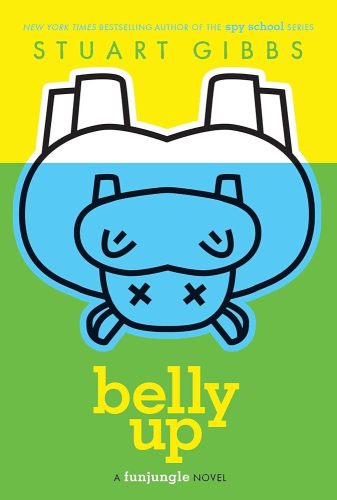
Belly Up is the first book in the FunJungle series of books. It is the tale of twelve-year-old Teddy Fitzroy who lives just outside a large zoo / amusement park. When the beloved park mascot, Henry Hippo, abruptly dies, Teddy suspects there’s more to the story. His sleuthing takes him on a suspenseful adventure filled with a whodunit mystery, harrowing close-calls, and more.

The entertainment value of this book is high; my middle schooler can’t get enough. For my taste, the questionable content is just barely palatable. Do I wish the author didn’t include the swear words and the underwear swimming scene? ABSOLUTELY. Would I ban my middle schooler from reading this book because of these things? No. Therefore, I gave this a “neutral w/ advisories” rating. I might have to use some white-out before sticking this one on the shelf.

Things I Liked:

  • animal facts and information about conservation efforts throughout
  • occasional utilization of higher level vocabulary (e.g. deign, groused, rube, segued, glibness, dirge, officious)
  • Teddy is determined to get to the truth and hold those responsible to account — admirable traits
  • suspenseful mystery keeps readers guessing until the end; great for critical thinking
  • humorous and entertaining; held my picky middle school reader’s attention
  • unethical actions have consequences
  • a close and loving relationship is portrayed between Teddy and his parents

Advisory Details:

  • moderate crude language (screwed, pissed off, bastard, idiot, jerk, crap, damn, ass)
  • practical jokes reference (p. 7)
  • fat-shaming/disrespect to an adult/authority figure (p.17)
  • sneaking around/ disobeying authority (p. 38, p. 145)
  • reference to possible suicide (of an animal) (p. 43)
  • a scene where Teddy and Summer go swimming in their underwear (p.95)
  • lying (a few separate incidences to avoid getting in trouble) (p. 103, 106)
  • glorification/justification of lying as a means towards an end (p. 107)
  • mild crush inferences (p. 115, p. 294)
  • reference to evolution, specifically reptiles being the ancestors of birds (p. 117)
  • reference to herpes without any further details, not specific to a type of herpes (p. 133)
  • reference to someone who ‘reeked of marijuana’ (p. 155)
  • describes autopsy of a dead hippo
  • gory scene where hippo guts get all over the audience (p. 251)

Note: This list is not exhaustive and may not capture every instance of questionable content, but rather is intended to give an overall sense of the content of the book.

Awkward (Graphic Novel)

Recommended Audience: Middle School +

Opinion: Recommended

Rival school clubs learn to work together after weeks of contention. Readers get to experience doing the right thing when faced with a moral dilemma, putting aside differences to work together, standing up to bullies, and more.

Advisories for mild crude language (e.g. pissed, jerk, idiot), mean-spirited jeering and name-calling (e.g. losers, dork), one reference to the ‘B-word’

Details:

At first glance of the cover, I automatically assumed that this book would have an overarching romance theme. Surprisingly, it doesn’t at all. The story revolves around two students, Penelope and Jaime, and their respective rival art and science clubs. Complete with middle school angst and melodrama, this book is quite humorous and overall wholesome. Aside from the name-calling and pranks, there’s really little to point out in terms of morally questionable content. However, if you wish to avoid stories that have a boy-girl friendship, this will be a book you would want to skip.

I think that middle school readers and up (perhaps even a mature 5th grader) will really enjoy this book. I love that the author relayed the message that art and science don’t have to be exclusive, and that in fact many famous people have been adept at both (p.188-190). Of course, I wish that the author had expanded the examples she gave beyond the Renaissance and Leonardo Da Vinci, but we’re not there yet. The scene where students stood up to the class bullies was a delight (p.208).

Things I Liked:

  • diversity of characters — the brilliant science teacher is a fierce woman of color, Jaime’s mom is in an electric wheelchair, and the newspaper staff reporter is a hijabi
  • resolution of conflict – ultimately the rival science and art clubs work together to achieve something great
  • doing the right thing – when faced with a moral dilemma, main character Penelope makes the right choice
  • consequences for the constant bickering and fighting between the two clubs
  • comedic elements – there were many comedic elements that didn’t come at the expense of character’s feelings

Advisories:

  • a vague inference to mammals having breasts (p.41) — I honestly think this would fly over most kids’ heads unless they’re familiar with mammals, and even then, it’s not really that bad
  • name-calling/teasing throughout (e.g. dork, nerd, losers)
  • mild crude language (e.g. pissed [p.93], stupid)
  • a character’s parent referring to the character’s mom as her “lazy BXXXX mother” (p. 104) — this is literally how it is written (with the X’s as it appears). I honestly don’t see why the author felt the need to include this. They could’ve got the same sentiment across without throwing in the expletive, even if it is written in a covert way.

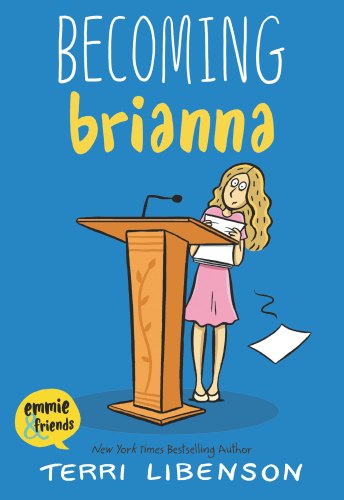
Becoming Brianna (Graphic Novel)

Recommended Audience: None.

Opinion: Pass. Not recommended.

While this book provides an opportunity to learn about Jewish culture, specifically bat mitzahs, Bri’s disinterest in her faith and other advisories make this book a no-go for me.

Details:

This is another book I had a hard time with. On the one hand, I believe that it’s really important for our readers to learn about other faiths and cultures, and their respective traditions. And for that reason, I liked this book. This story is about title character Brianna preparing for her bat mitzvah, a Jewish rite of passage. As she prepares, she questions her reasons behind agreeing to the bat mitzvah in the first place and if this tradition, and furthermore faith, is something she really believes in.

As a parent of faith whose roots are intertwined with Judaism and Christianity, Brianna’s resistance to learn and observe her faith is a bit off-putting. I wouldn’t want my own children to behave in such as way when it comes to Islam. When Brianna narrates how she “put her foot down” and refused to attend religious school in fifth grade because she had “more important things to do,” it bothered me, because again, this is not something I would want my own child to emulate in regards to their own faith.

On the flip side, as a Muslim parent, I don’t feel AS challenged by Brianna’s questioning of Judaism and Jewish rites. Brianna’s unwillingness to “blindly follow” is not threatening to me. It does get a bit complicated however because some of her sacrilegious thoughts regarding Judaism, carry over into Islam as we share many prophets (peace be upon them all) and narratives.

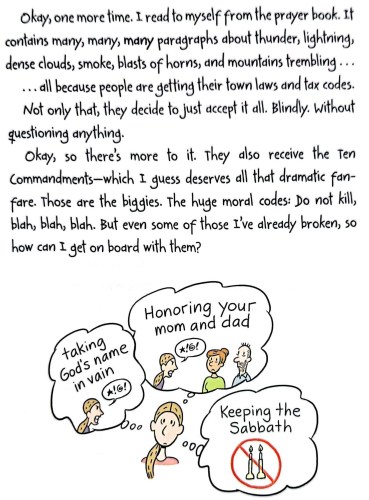
As an example, when describing her Jewish prayer book, she says “It contains many, many, many paragraphs about thunder, lightning, dense clouds, smoke, blasts of horns, and mountains trembling… all because people are getting their town laws and tax codes. Not only that, they decide to just accept it all. Blindly. Without questioning anything.” (p.161) The sarcastic tone used when referring to God’s commandments to the Jewish people didn’t sit well with me.

Ultimately, I have to ask myself if the value the book brings to the table is worth dealing with the issues it contains. In this case, I leaned with “no.” In addition to the concerns above, other advisories (outlined below) pushed this book just over the edge for me. I think there are other ways for our children to learn about other faiths and cultures in a respectful, engaging way. This book doesn’t have to be part of that journey. This book is far from the worst when it comes to questionable content, but if I’m in the position to say which books I would put in front of our Muslim kids, this is one that I wouldn’t recommend.

Things I Liked:

  • Brianna is a child of divorcees, bouncing between her two parents’ households. I appreciated that readers who might be living in similar situations will be able to relate
  • learning about the traditions and vocabularies of a bat mitzvah; it was insightful to see all that goes into the planning of the event and Bri’s mom’s antics were humorous
  • overall there wasn’t a heavy emphasis on topics that I would consider inappropriate
  • Bri’s rabbi seems friendly and approachable; I liked this because sometimes religious characters can be portrayed otherwise, simply because they are religious

Advisories:

  • an infographic seems to depict a variety of “non-traditional” families, including gay and lesbian couples (p. 18)
  • Brianna narrates that in fifth grade, she “put her foot down” and refused to go to religious school because she had “more important things to do” and “wasn’t that into it” — I’m concerned this is sending the wrong message to our readers (p. 20)
  • talks about liking boys (p. 35, 37, p. 82)
  • Brianna questions her beliefs in Judaism and its rituals (p. 71)
  • Brianna’s aunt talks about being an atheist (p. 115)
  • Bri’s father reflects on when he asked a girl out on a date (p. 127-129)
  • depiction of physical contact (hugs) between girls and guys (p. 138)
  • sacrilegious talks about God’s interactions and commandments with the Jews (p. 161)
  • party of middle school boys and girls dancing together depicted (p. 301-309)