
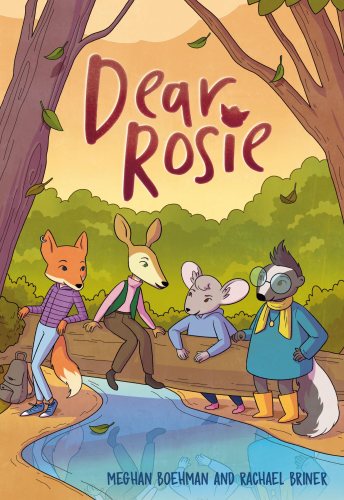
Dear Rosie (Graphic Novel)

Recommended Audience*: None.

Opinion: Do not recommend.

Synopsis: The concept behind this graphic novel–learning to cope with the grief of a close friend passing away–had so much potential but ultimately did not deliver. The story line was weak and had just enough questionable content to push it from the “neutral” to the “do not recommend” category.

Advisories: mild crude language, engaging in dangerous/illegal behavior, reference to online boyfriend, etc.

Details:

While I was perusing books at the library, this one caught my eye; I was excited to see a book about coping with grief after losing a friend. The concept had so much potential. Unfortunately the book fell flat. Main character Millie desperately misses her late friend Rosie. When she finds a notebook that has a symbol she associates with Rosie, Millie tries to find out how the notebook is connected to her friend.

During this anticlimactic quest, Millie and her friends end up trespassing and vandalizing property (adding graffiti to an abandoned property). Later in the book, when Millie’s friend is feeling overwhelmed with grief, she attempts to runaway but chickens out. Honestly, the behaviors depicted were in my opinion dangerous, and I would not want my Middle Schooler to engage in anything similar. While I appreciated that this may truly depict how some tweens and teenagers cope with loss, I didn’t feel like it’s something readers would really benefit from, nor would I want them to emulate these behaviors.

Ultimately, there were very few takeaways that I felt would be beneficial for readers and too many negative behaviors portrayed. I didn’t feel like the storyline was particularly engaging or compelling either. While there’s not a ton of questionable content, the book just didn’t offer much and I wouldn’t recommend it.

Things I Liked:

  • portrayal of friendship
  • depiction of main character working in family business

Detailed Advisories:

  • toilet humor: farting (p. 5)
  • mild crude language: stupid, jerk (p. 36, 103, 179)
  • name-calling: loser (p.45)
  • belittling someone for their old/damaged phone (p. 51)
  • disrespect to authority figure (teacher) (p.101)
  • reference to online boyfriend (p. 113-5)
  • trespassing (p. 124, 152-4)
  • running away (p. 168)
  • vandalism (p. 183-4)

Advisories Note: This list of advisories is not exhaustive and may not capture every instance of questionable content, but rather is intended to give an overall sense of the content of the book.

*Note: While we do not recommend this book to anyone, the intended audience indicated by the author/publisher is Middle Grades.

Awkward (Graphic Novel)

Recommended Audience: Middle School +

Opinion: Recommended

Rival school clubs learn to work together after weeks of contention. Readers get to experience doing the right thing when faced with a moral dilemma, putting aside differences to work together, standing up to bullies, and more.

Advisories for mild crude language (e.g. pissed, jerk, idiot), mean-spirited jeering and name-calling (e.g. losers, dork), one reference to the ‘B-word’

Details:

At first glance of the cover, I automatically assumed that this book would have an overarching romance theme. Surprisingly, it doesn’t at all. The story revolves around two students, Penelope and Jaime, and their respective rival art and science clubs. Complete with middle school angst and melodrama, this book is quite humorous and overall wholesome. Aside from the name-calling and pranks, there’s really little to point out in terms of morally questionable content. However, if you wish to avoid stories that have a boy-girl friendship, this will be a book you would want to skip.

I think that middle school readers and up (perhaps even a mature 5th grader) will really enjoy this book. I love that the author relayed the message that art and science don’t have to be exclusive, and that in fact many famous people have been adept at both (p.188-190). Of course, I wish that the author had expanded the examples she gave beyond the Renaissance and Leonardo Da Vinci, but we’re not there yet. The scene where students stood up to the class bullies was a delight (p.208).

Things I Liked:

  • diversity of characters — the brilliant science teacher is a fierce woman of color, Jaime’s mom is in an electric wheelchair, and the newspaper staff reporter is a hijabi
  • resolution of conflict – ultimately the rival science and art clubs work together to achieve something great
  • doing the right thing – when faced with a moral dilemma, main character Penelope makes the right choice
  • consequences for the constant bickering and fighting between the two clubs
  • comedic elements – there were many comedic elements that didn’t come at the expense of character’s feelings

Advisories:

  • a vague inference to mammals having breasts (p.41) — I honestly think this would fly over most kids’ heads unless they’re familiar with mammals, and even then, it’s not really that bad
  • name-calling/teasing throughout (e.g. dork, nerd, losers)
  • mild crude language (e.g. pissed [p.93], stupid)
  • a character’s parent referring to the character’s mom as her “lazy BXXXX mother” (p. 104) — this is literally how it is written (with the X’s as it appears). I honestly don’t see why the author felt the need to include this. They could’ve got the same sentiment across without throwing in the expletive, even if it is written in a covert way.