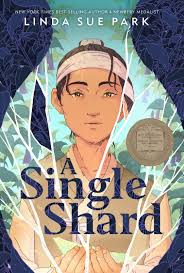
A Single Shard by Linda Sue Park

Recommended Audience: Upper Elementary and Middle School readers/ Children aged 8-14

Opinion– Recommended

Synopsis: Set in 12th century Korea, orphan Tree-ear lives under a bridge in a small village spending his days with a kindly man he calls Craneman. Together, they eke out a meager living foraging and digging through the village’s midden heaps. Despite his love for Craneman, Tree-ear begins looking to the future. He happens upon a famous potter in his village and falls in love with the art of pottery. A Single Shard follows Tree-ear’s journey as he works hard to achieve his dream.

Advisories: mention of the word ‘concubine’ and a group suicide as part of a Korean myth

Details: I came across this title doing research on age-appropriate books to read with my upcoming students. As a historical fiction lover myself, I was intrigued because A Single Shard takes place in a time period I love, but in a place I admittedly know very little about: Korea. After reading the blurb, I added it to my list for review. I recommend this award-winning book on the merit of its writing, character development, and alignment with various Islamic values.

I appreciate Linda Sue Park’s rich writing as well as how she conveyed meaning to me as a reader without dumbing down the language. I could easily imagine myself standing in the forest surrounded by the lush green trees and digging clay on the riverbank next to Tree-ear. Most of all, I appreciate Park’s characterization of Tree-ear, Craneman, and Min the Potter. The descriptions of making and decorating pottery along with day to day life in a medieval Korean village made for an enjoyable read as well.

Character development is another strong aspect to A Single Shard. Readers never find out how old Tree-ear is exactly, but he seems to be between 11-13. He may not be as outrageous or adventurous as some more popular male protagonists, but he possesses grit and resilience. Throughout the story, Tree-ear is faced with moral dilemmas and he frequently falls back on the insight Craneman has given him over the years. More than once, Tree-ear defers to what he thinks Craneman would do as a trusted adult. Tree-ear is also respectful of his elders and never talks back to them. Although Tree-ear’s beliefs do not stem from Islam, they don’t contradict them either. He has a strong sense of right and wrong, respects his elders, refuses to beg for food, and does his best to make sure he does the right thing despite making things harder for himself. Additionally, he keeps his word and works extremely hard not only to work off a debt, but to achieve his dream. Although Craneman was a secondary character, it is plain that his wisdom and careful storytelling impacted Tree-ear in many ways. Additionally, Min undergoes a transformation as he lets go of some serious grief to embrace life.

There are mentions of Buddhism and a Buddhist temple in the story, but there are no explanations or descriptions of practices or rituals. The characters use the temple bells to mark time, but give no indication that they are Buddhists themselves.

Teacher’s Note: This book could lend itself to a plethora of unit studies and interdisciplinary lessons in both a secular or Islamic environment. It could tie into Asian American and Pacific Islander Month or be used to investigate the historical aspects of that time period, specifically for 7th graders. There are also many instances in the story that could spark conversations about right and wrong, societal expectations, grief, friendship, and hard work. Since I focus on novel studies in my class, I plan to read this with my students and study the story structure, vocabulary, and historical period. I look forward to discussing this with my students.

Things I Liked:

  • Craneman and Tree-ear’s genuine concern for one another
  • Tree-ear’s commitment to hard work, a moral code, and his dream
  • View into a different culture
  • The nuances–This book isn’t a difficult read, but it does require a certain level of attention to pick up on the nuances of the story. (Additional teacher’s note: this is a skill many students need to practice.)
  • Tree-ear’s commitment to hard work, a moral code, and his dream

Detailed Advisories:
At one point, Craneman does tell Tree-ear a story of a group of a king’s concubines (pg. 110) that choose to throw themselves off a cliff rather than be captured by the enemy. The story is told as an example of courage, but Craneman does go on to tell Tree-ear that “…leaping into death is not the only way to show true courage” (pg. 111). This may necessitate a conversation about how suicide is haram and not an option for us as Muslims, but I do like that Craneman suggests there are other ways to deal with our problems.

Final Thoughts: It’s a good story with no inappropriate words or actions, many characters have redeemable qualities. Furthermore, it gives opportunities for discussion about how to handle situations.

My Side Of The Mountain

Recommended Audience: Middle Grades +

Opinion: Recommended

Rating: 8.5/10 — I enjoyed this book, it was entertaining and fun to read.

Synopsis: Sam runs away to the mountains from his family’s crowded apartment, with just five small items. There he must rely upon himself and the great outdoors to survive.

Lessons Learned: Skills used in nature and the bond made between nature and a boy.

Advisories: In this book there is nothing of concern except for guns mentioned to shoot deer

Note: This list of advisories is not exhaustive and may not capture every instance of questionable content, but rather is intended to give an overall sense of the content of the book.

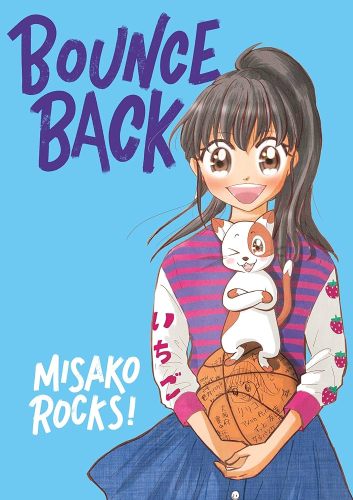
Bounce Back (Graphic Novel)

Recommended Audience: None.

Opinion: Do not recommend.

Synopsis: This graphic novel did not offer much in way of neither entertainment nor moral value. While the book does not contain egregiously questionable content, nor is it plentiful, the fact that the story itself was hardly engaging and the moral takeaways were minimal made this book a ‘pass’ for me.

Advisories: bullying/teasing, mild crude language, dating, kissing, and more

Note: I write this review with the caveat that I am far from a connoisseur when it comes to manga. I don’t read much of it, and I don’t particularly seek it out. A manga fan might have an entirely different opinion on this book.

Details:

This manga-style graphic novel has readers following along as Lilico, a middle school girl from Osaka who loves basketball, migrates from Japan to the United States. Lilico struggles to adjust to her new home and has to deal with harsh bullies as she tries to find her way. Lilico’s talent in basketball paves a path for her to gain popularity, but at what cost? Lilico must remind herself what it means to be a good friend and find ways to build bridges between peer groups.

This book fell flat for me. I found the melodrama of the book to be off-putting, but I recognize this can be a trait of manga. I felt that Lilico’s strategies to gain friends and repair relationships were weak at best and not strategies I would want my own children to employ. In order to win over her bully, Lilico basically proves herself on the basketball court and becomes a major asset to the girls basketball team. In order to build bridges between two rivals, she encourages Nala to design and create a team mascot costume for the school. I don’t like that in both scenarios, the characters had to offer some type of service/skill in order to curry favor with those who were treating them badly.

Sometimes if the moral takeaways and overall value of the book in one fashion or another is compelling enough, I can forgive some indiscretions in terms of questionable content. Ultimately, this book did not meet that threshold for me therefore I do not recommend it.

Things I Liked:

  • Lilico learned to stand up for herself against bullies but not in a particularly compelling way — she basically proved her value to them via her basketball talent
  • Lilico mended her friendship with Nala
  • Learning about Japanese culture (food, school experiences, clothing, beliefs, etc.)

Advisory Details:

  • references to being someone else in a “past life” (p. 15)
  • bullying, teasing (recurring)
  • mild crude language — shut up, crap
  • “guardian spirit” character that possesses a cat and assists Lilico (introduced on p. 50 and recurring thereafter)
  • boy and girls hanging out unsupervised in a character’s bedroom (p. 58)
  • eating pork (p. 85)
  • reference to a specific food believed to bring good luck (p.86)
  • boy and girls sleeping over together (p. 88)
  • reference to getting a boyfriend, crushes (p. 94, 139)
  • fan-girling over bands (p. 139)
  • dating (p. 176-7, 190-2)
  • boy-girl hugging (p. 218)
  • boy-girl kissing (p. 255)

Note: This list of advisories is not exhaustive and may not capture every instance of questionable content, but rather is intended to give an overall sense of the content of the book.

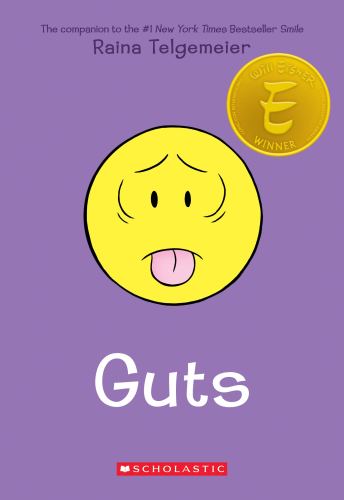
Guts (Graphic Novel)

Recommended Age: Middle School and Up

Opinion: Squeamishly Recommended

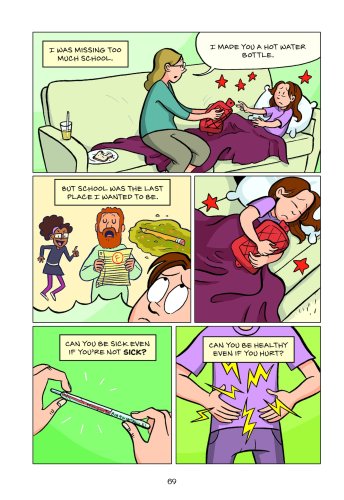
This book contains good messages such as the normalization of attending therapy, supporting peers when they’re ill, and learning coping strategies for anxiety. There’s hardly anything I would call morally questionable, however the constant mentioning of vomiting, going to the bathroom, and upset stomachs makes this reviewer a bit squeamish.

Advisories: cartoon portrayals of vomit, poop, and sitting on the toilet; name-calling and teasing, and a few other minor things

Details:

Guts is not going to be the book for everyone, especially if they’re a bit squeamish like me, but it is still a book I recommend. The overall theme of learning to navigate phobias and anxiety with the support of a therapist is a really important takeaway. I appreciate that more authors are bringing light to mental health issues such as this. Some readers will relate to the main character Raina and how her anxiety manifests in physical symptoms such as upset stomachs and needing to go the bathroom. Other readers will at least be able to learn more about these conditions and hopefully develop empathy and consideration for those who may be affected. This is a book I would keep on my shelf and would recommend to others (unless they’re really squeamish!).

Things I Like:

  • diversity of characters — Example: Raina’s good friend is Korean American and mentions of her food comes up more than once (ex: p. 95)
  • Raina learns different coping strategies from her therapist to deal with her phobias and anxiety (ex: p. 108, 153) and shares these with peers (p. 180-182)
  • classmates make a large get-well poster for an ill peer (p.192-193)
  • normalization of going to therapy (p. 200)

Advisories:

  • cartoon portrayal of vomit (p. 9)
  • Raina is depicted sitting on a toilet with her pants down (p. 30, 42)
  • name-calling and teasing (p. 10, 49, 92)
  • cartoon portrayal of a fecal sample [eww…] (p. 167)
  • discussion about periods (p. 197) — while there’s nothing inherently wrong with this, some parents may not be ready to introduce this idea to their reader
  • character mentions her father gets drunk sometimes and yells (p. 198)