
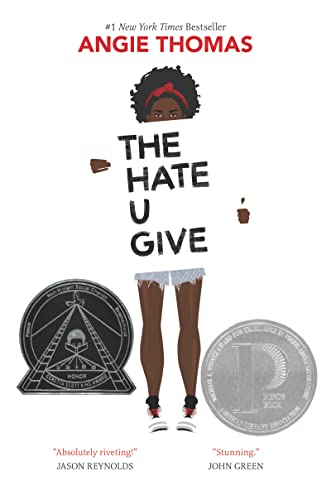
The Hate U Give Review

Target Audience: Young Adult/Teens

Opinion: Do Not Recommend (Sadly)

Synopsis: Starr Carter witnesses the murder of her friend Khalil at the hands of the police during a traffic stop. She grapples with the aftermath both with the trauma of what she witnesses and how to seek justice for Khalil in an unjust system. She ultimately finds the courage to come forward as a witness of the murder, only to learn that the officer involved would not be indicted. Readers will gain perspective on systemic racism and social inequality, important in an ever-polarized world. 


Advisories: profanity***, kissing/making out/groping, dating, unwed pregnancy, prostitution inferences, drug references, gang violence, police brutality, drug addiction, domestic violence, LGBT+ inference

Details:

As I sit here trying to write this review, I want to be able to say ‘undecided’, or give the book a “neutral” rating, because there is so much to be gained in reading this multi-award winning novel. Perspective. Social (in)Justice awareness. Activism. Speaking truth to power. And so much more. It is an unfortunate reality that in wanting to shelter our children from many of the inappropriate elements in this book, we also shelter them from the harsh realities of racism, social inequality, income disparities, and so many more of the very lived challenges that a significant proportion of our ummah deal with.

At the end of the day, readers will have benefited greatly from reading this book and likely, despite its inappropriate content, I can honestly say that they will be a better person for having read it. And it is for those reasons that I so desperately want to be able to recommend this book and to add it to the high school section of our Islamic school library, but alas, I cannot. I just can’t look a parent in the eye and justify shelving a book that contains nearly 100 F-bombs, over 200 uses of the word sh**, and nearly every form of profanity you can think of.

It’s not just the profanity though, although that would be the first thing a reader would notice–you can’t hardly read through a single page without coming across at least one curse word. The novel is written from the perspective of Starr Carter, a young Black woman growing up in Garden Heights (“the hood”) and attending a predominately white high school in the suburbs. Starr is a courageous, compassionate young woman who finds it within herself not just to stick up to her so-called ‘friend’ and their racist comments, but to an entire system that regularly oppresses people of color.

At the same time, being that Starr is a teenager living in a community that grapples with many morally complex social issues, her life is portrayed complete with profanity, normalization of alcohol and drug use, gang activity, teenage dating and sex, and crude humor. Truth be told, there were gang and drug references that I was not even familiar with as an adult reader. While I want young Muslim readers to gain insight into the realities of racism, injustice, social inequality, and more, it is not my wish that they become initiated into the inner workings of drug lords and gangbangers. My mission now is to try to find more literature that addresses the social justice themes and would be appropriate for our young readers.
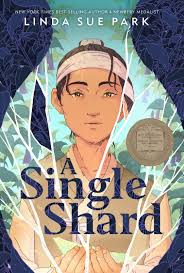
A Single Shard by Linda Sue Park

Recommended Audience: Upper Elementary and Middle School readers/ Children aged 8-14

Opinion– Recommended

Synopsis: Set in 12th century Korea, orphan Tree-ear lives under a bridge in a small village spending his days with a kindly man he calls Craneman. Together, they eke out a meager living foraging and digging through the village’s midden heaps. Despite his love for Craneman, Tree-ear begins looking to the future. He happens upon a famous potter in his village and falls in love with the art of pottery. A Single Shard follows Tree-ear’s journey as he works hard to achieve his dream.

Advisories: mention of the word ‘concubine’ and a group suicide as part of a Korean myth

Details: I came across this title doing research on age-appropriate books to read with my upcoming students. As a historical fiction lover myself, I was intrigued because A Single Shard takes place in a time period I love, but in a place I admittedly know very little about: Korea. After reading the blurb, I added it to my list for review. I recommend this award-winning book on the merit of its writing, character development, and alignment with various Islamic values.

I appreciate Linda Sue Park’s rich writing as well as how she conveyed meaning to me as a reader without dumbing down the language. I could easily imagine myself standing in the forest surrounded by the lush green trees and digging clay on the riverbank next to Tree-ear. Most of all, I appreciate Park’s characterization of Tree-ear, Craneman, and Min the Potter. The descriptions of making and decorating pottery along with day to day life in a medieval Korean village made for an enjoyable read as well.

Character development is another strong aspect to A Single Shard. Readers never find out how old Tree-ear is exactly, but he seems to be between 11-13. He may not be as outrageous or adventurous as some more popular male protagonists, but he possesses grit and resilience. Throughout the story, Tree-ear is faced with moral dilemmas and he frequently falls back on the insight Craneman has given him over the years. More than once, Tree-ear defers to what he thinks Craneman would do as a trusted adult. Tree-ear is also respectful of his elders and never talks back to them. Although Tree-ear’s beliefs do not stem from Islam, they don’t contradict them either. He has a strong sense of right and wrong, respects his elders, refuses to beg for food, and does his best to make sure he does the right thing despite making things harder for himself. Additionally, he keeps his word and works extremely hard not only to work off a debt, but to achieve his dream. Although Craneman was a secondary character, it is plain that his wisdom and careful storytelling impacted Tree-ear in many ways. Additionally, Min undergoes a transformation as he lets go of some serious grief to embrace life.

There are mentions of Buddhism and a Buddhist temple in the story, but there are no explanations or descriptions of practices or rituals. The characters use the temple bells to mark time, but give no indication that they are Buddhists themselves.

Teacher’s Note: This book could lend itself to a plethora of unit studies and interdisciplinary lessons in both a secular or Islamic environment. It could tie into Asian American and Pacific Islander Month or be used to investigate the historical aspects of that time period, specifically for 7th graders. There are also many instances in the story that could spark conversations about right and wrong, societal expectations, grief, friendship, and hard work. Since I focus on novel studies in my class, I plan to read this with my students and study the story structure, vocabulary, and historical period. I look forward to discussing this with my students.

Things I Liked:

  • Craneman and Tree-ear’s genuine concern for one another
  • Tree-ear’s commitment to hard work, a moral code, and his dream
  • View into a different culture
  • The nuances–This book isn’t a difficult read, but it does require a certain level of attention to pick up on the nuances of the story. (Additional teacher’s note: this is a skill many students need to practice.)
  • Tree-ear’s commitment to hard work, a moral code, and his dream

Detailed Advisories:
At one point, Craneman does tell Tree-ear a story of a group of a king’s concubines (pg. 110) that choose to throw themselves off a cliff rather than be captured by the enemy. The story is told as an example of courage, but Craneman does go on to tell Tree-ear that “…leaping into death is not the only way to show true courage” (pg. 111). This may necessitate a conversation about how suicide is haram and not an option for us as Muslims, but I do like that Craneman suggests there are other ways to deal with our problems.

Final Thoughts: It’s a good story with no inappropriate words or actions, many characters have redeemable qualities. Furthermore, it gives opportunities for discussion about how to handle situations.